I feel like I'm 10× more productive than I was just 3 months ago.
Let me explain.
For better or worse, some things over the past year forced me personally and as a business owner to really lean into AI and rethink how I work.
I will be honest, I was skeptical at first. Between compliance, trust, and the responsibility that comes with operating in the government contracting space, moving fast with AI didn't feel like an obvious choice. But avoiding it wasn't really an option either.
As I started incorporating AI tools into my routine, my workflow changed pretty significantly. Here's what my day-to-day personal stack looks like right now:
- Superwhisper: Voice narration (works great for hands-fee prompts!)
- ChatGPT: for day-to-day knowledge work, thinking, writing, and sense-making
- Claude Code + Cursor: for software development and prototyping
- Google Gemini: for content generation, visuals, and creative brainstorming
- Figma: for UX and flow thinking
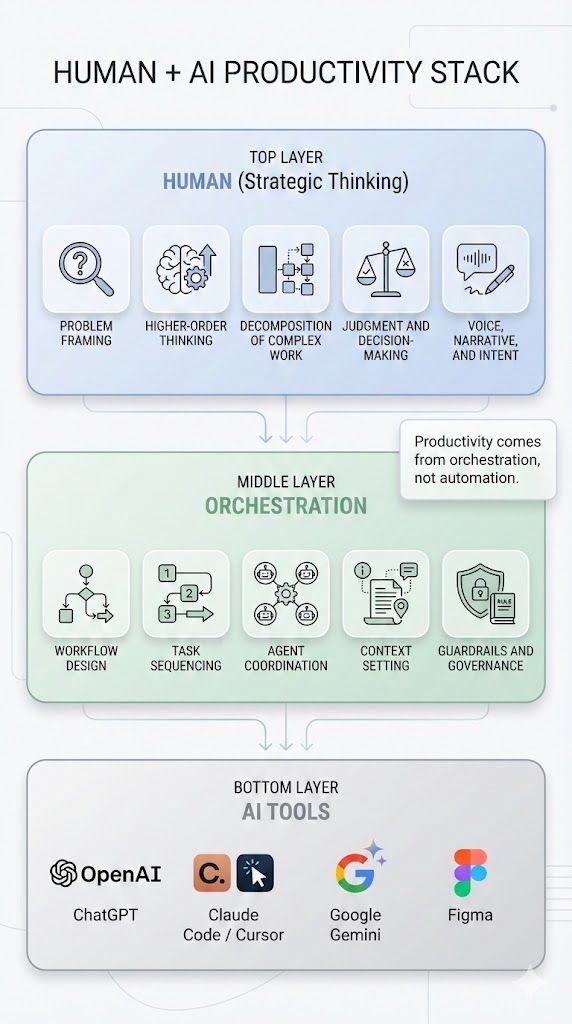
At times, I find myself running 3–4 agents in parallel, moving work across them.
The interesting part though isn't the tools.
What has made the biggest difference is higher-order thinking -- slowing down enough to frame the problem properly, then breaking big, fuzzy ideas into small, concrete pieces of work.
The results are really good when the problem is clear, and pretty bad when it isn't.
Designing the workflow, deciding what gets done where, setting context, and stitching things back together has become a real skill. Probably the skill required to be successful in this operating model.
Having said that, none of this works without guardrails. There's still tension between moving faster and doing this responsibly, especially in regulated environments. This is still very much a human-led model, with AI supporting thinking and execution, not replacing it.
So we're being intentional about governance around agents. Clear boundaries, humans in the loop where it matters, and thoughtful approaches to data, security, and accountability.
So far, I've found that AI doesn't replace thinking. If anything, it requires deeper thinking and planning upfront and exposes weak thinking faster.
One more thing that surprised me.
I am not only getting more done but am doing work I actually care about and enjoy -- and as a result, I am happier.
The productivity is real, but the bigger shift is focus, mental health and leverage. We will see how this space evolves.
Curious how others are navigating this balance in their own workflows.
Footnote
Human ~70% (ideas, voice, judgment)
AI ~30% (graphics, refinement, cleanup)
Originally published on LinkedIn.